Swiss technology company AMiquam reports advances in the sensitivity of its in-situ eddy current inspection technology for metal additive manufacturing, with detection of defects as small as 0.1 mm in thin-walled components made by laser powder bed fusion. The results were presented in a technical publication ahead of Formnext 2026 and indicate the potential to inspect parts layer by layer during production rather than relying only on post-build non-destructive testing.
Sensor integrated into the recoater
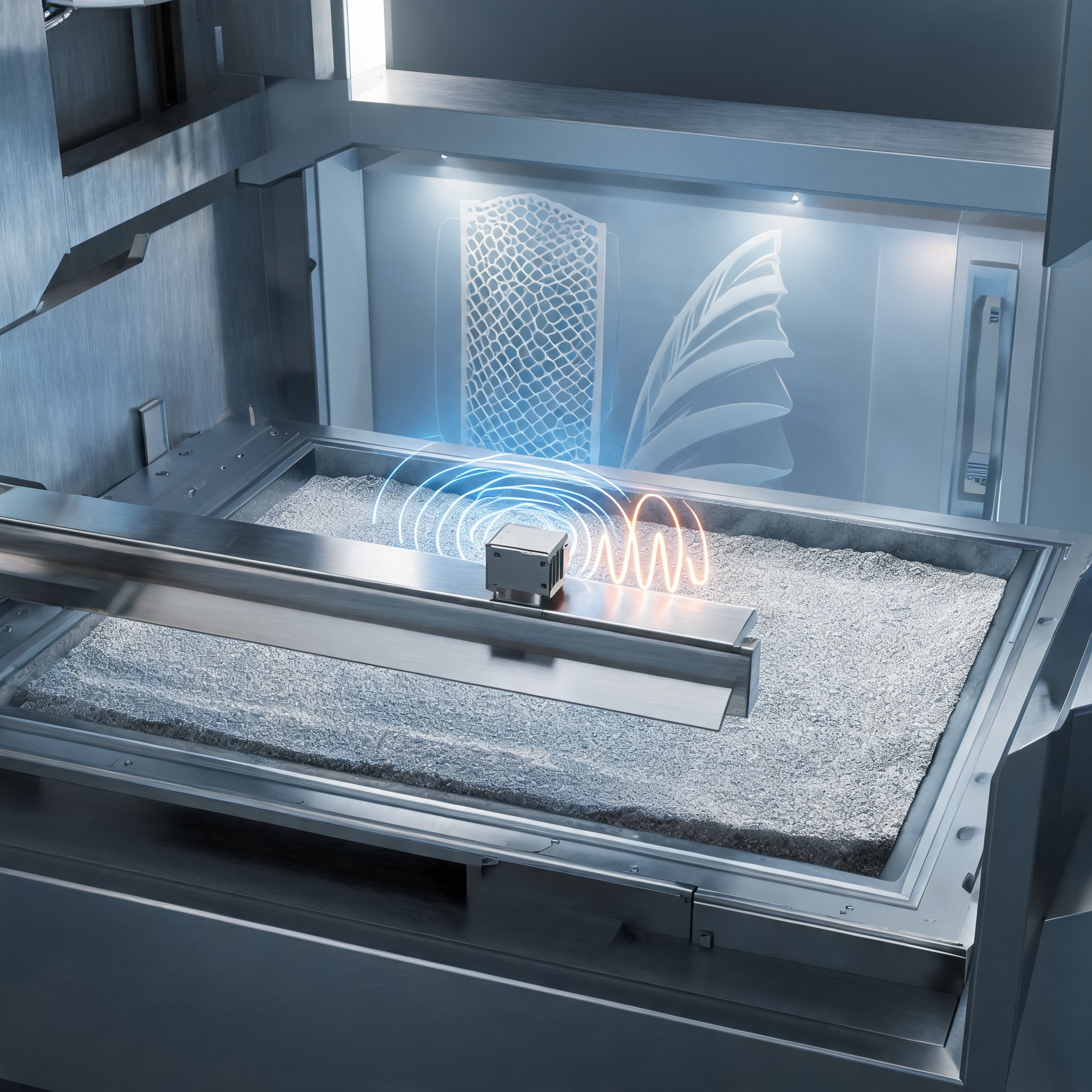
AMiquam's approach uses an eddy current sensor integrated into the recoater assembly of an LPBF machine. As the recoater moves across the build platform, the sensor scans each newly deposited layer and records electromagnetic signals that can reveal indications associated with internal defects. Inspection data is then mapped to the component geometry, allowing detected anomalies to be located and reported automatically.
0.1 mm indications in thin walls
In one test, AMiquam used a 316L stainless steel specimen with a 0.7 mm wall thickness and five artificially introduced holes ranging from 0.1 mm to 0.5 mm in diameter. Both through-holes and blind holes produced distinct peaks in the eddy current signal, and the smallest 0.1 mm indication was clearly distinguishable from background signal variations. Measurements were collected across approximately 127 layers, with each hole producing a corresponding signal peak as the build progressed.
The company says the results indicate potential for inspecting complex structures such as triply periodic minimal surface heat exchangers, where internal channels and thin walls can make conventional post-process inspection difficult. AMiquam also describes a concept for an inspection certificate covering material, layer coverage, detection limits and detected indications. The certificate shown in the publication is an illustrative example, not an actual component certification.
Aeroengine blade structures
A second application focuses on LPBF-manufactured aeroengine blades in which different laser scanning strategies create distinct microstructures within the same part. The blade design uses a conformal laser scanning strategy in the surface skin, while the bulk material is made with a conventional chessboard scanning approach. These processing differences influence the microstructure and therefore the eddy current signals generated during inspection.
AMiquam reports a defect detection capability of approximately 0.2 mm within the conformal skin. In the bulk material, the detection threshold is approximately 0.5 mm, where microstructure variations generate additional signal fluctuations that can make smaller indications harder to distinguish. The company notes that sensitivity depends on material characteristics, laser scanning strategy and component geometry, and that optimising laser strategies could potentially improve detection performance in bulk regions.
Defect location and earlier quality insight
Beyond detecting defects, the technology is designed to establish their location within the manufactured component. Eddy current signals recorded during each recoating operation are mapped onto the part geometry, and software automatically identifies indications that exceed predefined thresholds and assigns their positions in X, Y and build-layer coordinates. This provides spatial information that can help identify where defects occur and support later investigation into their origin.
Capturing data throughout the build could give manufacturers earlier insight into potential quality issues instead of discovering them only after completion. AMiquam says the results point to a role for eddy current inspection in metal additive manufacturing quality assurance, particularly for complex internal geometries and safety-critical parts in aerospace, energy and medical manufacturing, where qualification and traceability matter. The company also cautions that detection thresholds remain dependent on geometry, material and manufacturing parameters, so the reported results should be considered application-specific rather than universal performance limits.