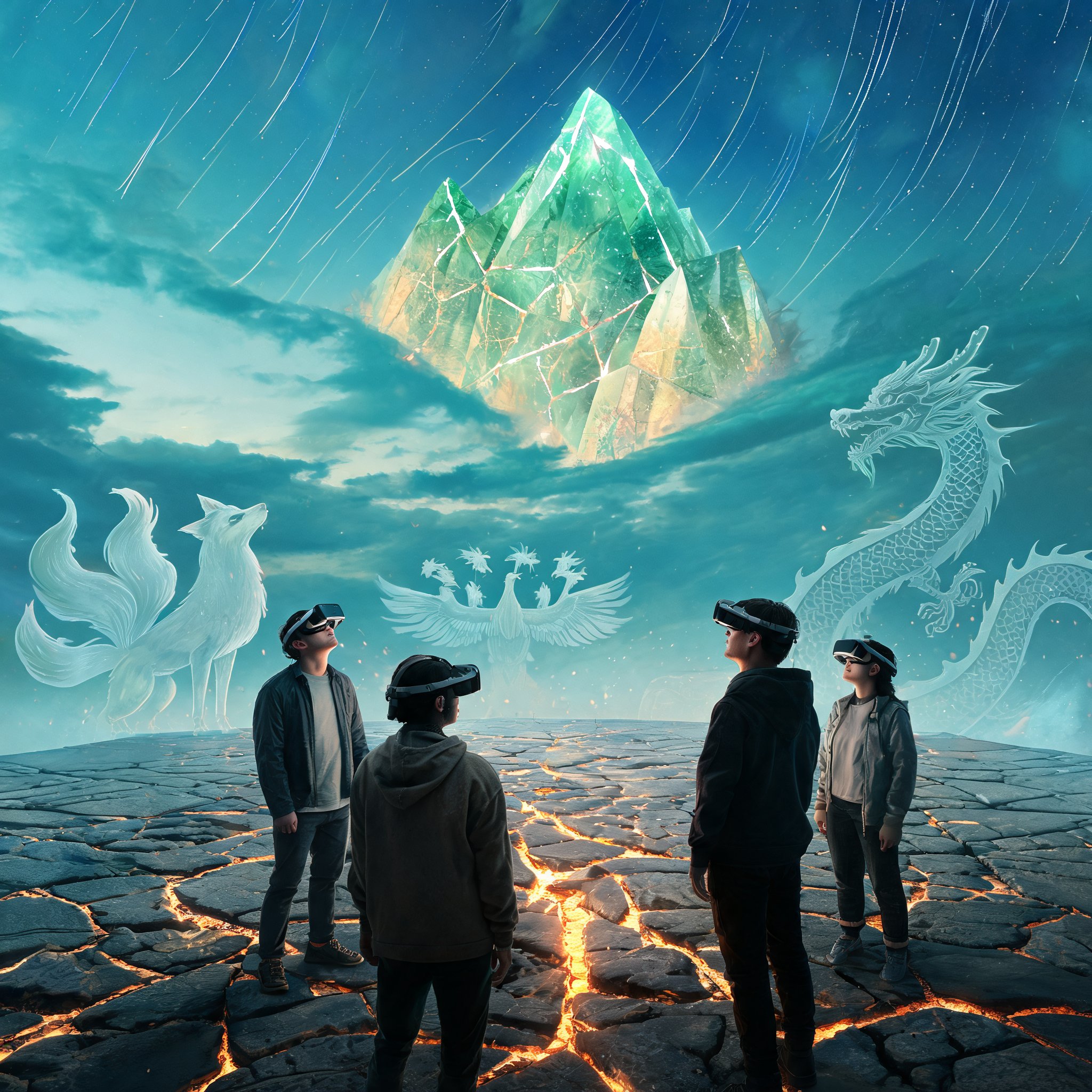
AStation has built Shan Hai Jing™, a location-based mixed reality experience that places visitors inside one of China's oldest surviving myth cycles. Guests wear Apple Vision Pro headsets and move through up to 2,000 square metres of outdoor ground, where digital scenery is aligned to the real landscape around them. Up to 120 people can share a session, so a group witnesses the same events together rather than one at a time.
The attraction is not screen-based. Visitors keep sight of their friends and their actual surroundings while a mixed reality mountain appears among them — the point at which the story begins.
A mythology older than the Great Wall
Shan Hai Jing, the Classic of Mountains and Seas, began as a written collection of myths set down more than two thousand years ago, describing strange lands, strange animals and gods. AStation compares its place in Chinese culture to that of Greek mythology in the West, while noting that very few people outside China know the stories.
The experience centres on Nuwa, a goddess who repairs a broken sky. In AStation's staging, a god enraged by the loss of a great battle strikes the mountain that holds up the heavens; it breaks, the sky tilts and the earth drops away on one side. The original storytellers used the myth to account for what they saw in nature, including why China's rivers run toward the sea and why the stars appear to wheel overhead. Guests are shown the same sequence, including the sensation of the ground tilting beneath their feet.
Creatures of the crumbling sky
Visitors then enter what AStation calls the "Realm of the Crumbling Sky." More than a dozen scenes appear, and hundreds of creatures drawn from the old stories approach the group — nine-tailed foxes, nine-headed birds, dragons and beings that are part human, part animal. The deeper guests walk, the more of the legend those creatures reveal, until the group is moving through a story older than the Great Wall of China.
All of it runs on Enterverse™, AStation's own platform, which overlays the myth directly onto outdoor ground without wires, handheld controllers or an indoor stage. The story is not projected onto a screen; it is mapped to the surface beneath the visitors, which is why the shared session can scale to a large crowd.
Harmony as the takeaway
Beyond spectacle, AStation frames the piece around a value it says still matters in Chinese culture today. Anger breaks the world; Nuwa melts coloured stones to patch the sky and restore balance. That idea — when something breaks, someone must take on the patient work of repairing it — is carried in the concept of héxié (和谐), harmony, which the company says continues to shape how many Chinese people understand their duty to one another.
AStation links the work to a broader cultural revival in China, in which parts of society are re-embracing older traditions, and notes that culture and technology are both core pillars of the country's current Five-Year Plan. It cites that backdrop as a likely factor in its own rapid domestic growth.
Production notes
The company states that Shan Hai Jing was produced entirely in-house, with no external partners. It also clarifies that its accompanying promotional video discusses a different title, Cosmos, purely as an example of how a story can unfold on the Enterverse platform generally; Shan Hai Jing, built on the same platform, is the work submitted in this category.