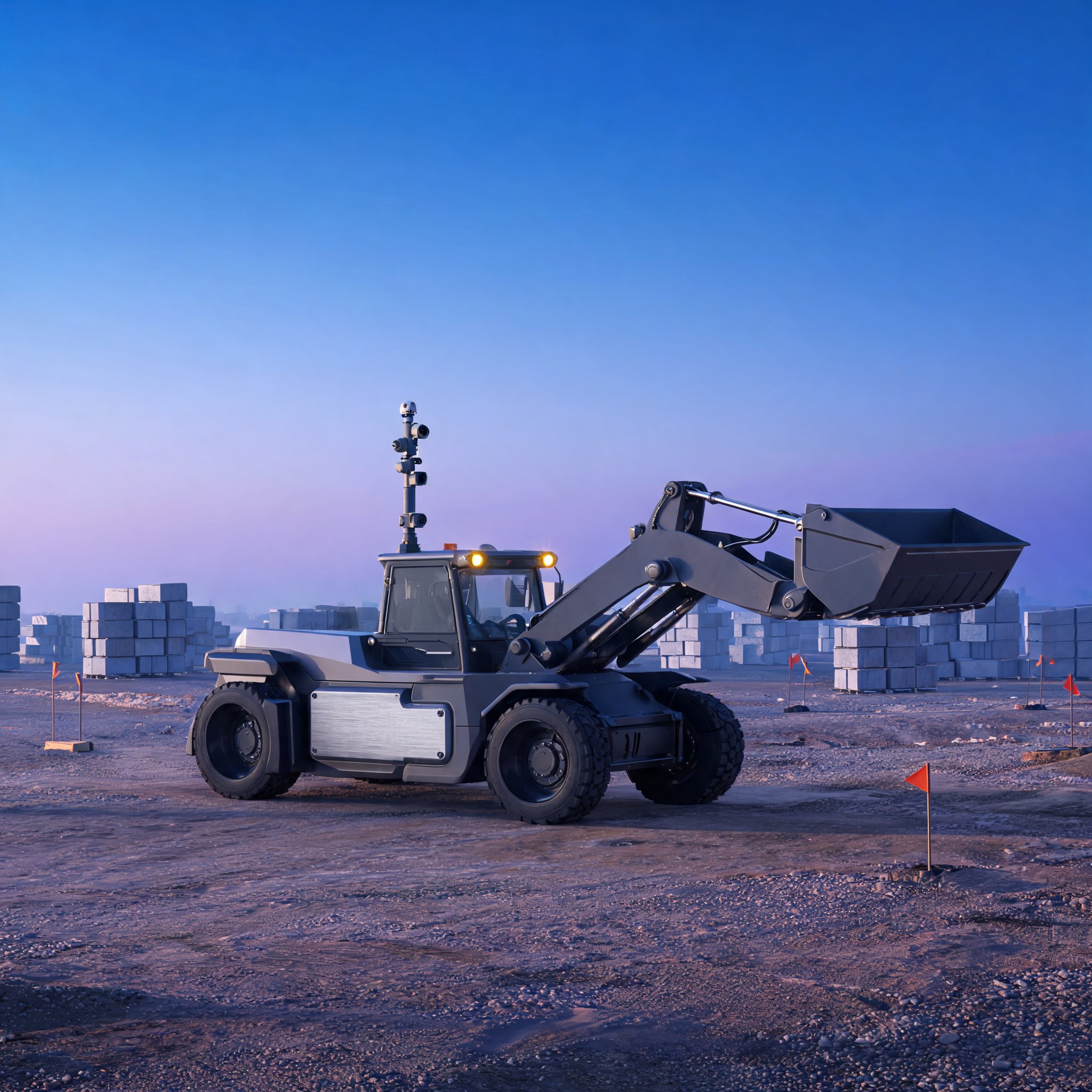
Bobcat Company has received its second Red Dot Award: Design Concept, this time for the RogueX3, a fully electric, autonomous and modular concept loader. The recognition follows the design award given to the RogueX2 concept platform in 2024.
According to Bobcat, the award reflects its continued exploration of adaptable machine architectures aimed at workforce challenges, sustainability goals and increasingly connected job sites.
Simplified lift architecture
Central to the design is a patent-pending, rear-mounted linear actuator tilt system. The arrangement replaces traditional front hydraulic cylinders and cuts the number of mechanical components by more than 50 percent compared with a typical compact loader. Bobcat frames the reduction in hydraulic complexity as a way of exploring how future compact equipment could be easier to maintain, more energy-efficient and better suited to increasingly automated job sites.
The concept also integrates the battery into the chassis and uses an electric drivetrain for zero-emission operation. Placing the battery in the chassis lowers the machine's centre of gravity while creating a more streamlined architecture, the company says.
One platform, several configurations
RogueX3 is designed to support tracked or wheeled mobility, cabbed or cabless operation, multiple lift-arm geometries and configurable power systems, allowing a single platform to be adapted to different terrains, industries and future job site requirements.
For autonomous functionality, the concept uses technology capable of real-time kinematic positioning, GPS navigation, sensors and cameras. It can also be operated remotely through Bobcat MaxControl, a system designed to control equipment from outside the cab using an iPhone or any device running the iOS operating system. Bobcat says future work with AI-enabled lighting systems explores how equipment could communicate machine activity, such as status and intent, to people on the job site.
Still a research platform
The RogueX3 was developed through collaboration between Bobcat's Global Design Studio, Global Innovation and engineering teams, and serves as a research platform for testing technologies and design approaches that could help shape future generations of Bobcat equipment. It was introduced at CES 2026 and remains in the research and development stage; it is not commercially available.
Jim Breuer, director of global product identity at Bobcat, said the award recognises the company's commitment to exploring the future of equipment through the RogueX platform, and that RogueX3 shows what is possible when industrial design and engineering come together to turn autonomy, electrification and modular architecture into a tangible vision for tomorrow's job sites.
Joel Honeyman, vice president of global innovation, product insights and dealer enablement at Bobcat, said customer needs are evolving and job sites are becoming more connected, which he argues means equipment must become more adaptable. He said RogueX3 explores how a single machine platform could respond to those changing demands, with a modular design intended to adapt to different jobs, terrains and power systems, an approach he described as something construction equipment has not done before and one that produces a simpler, more efficient architecture built around the needs of construction crews.