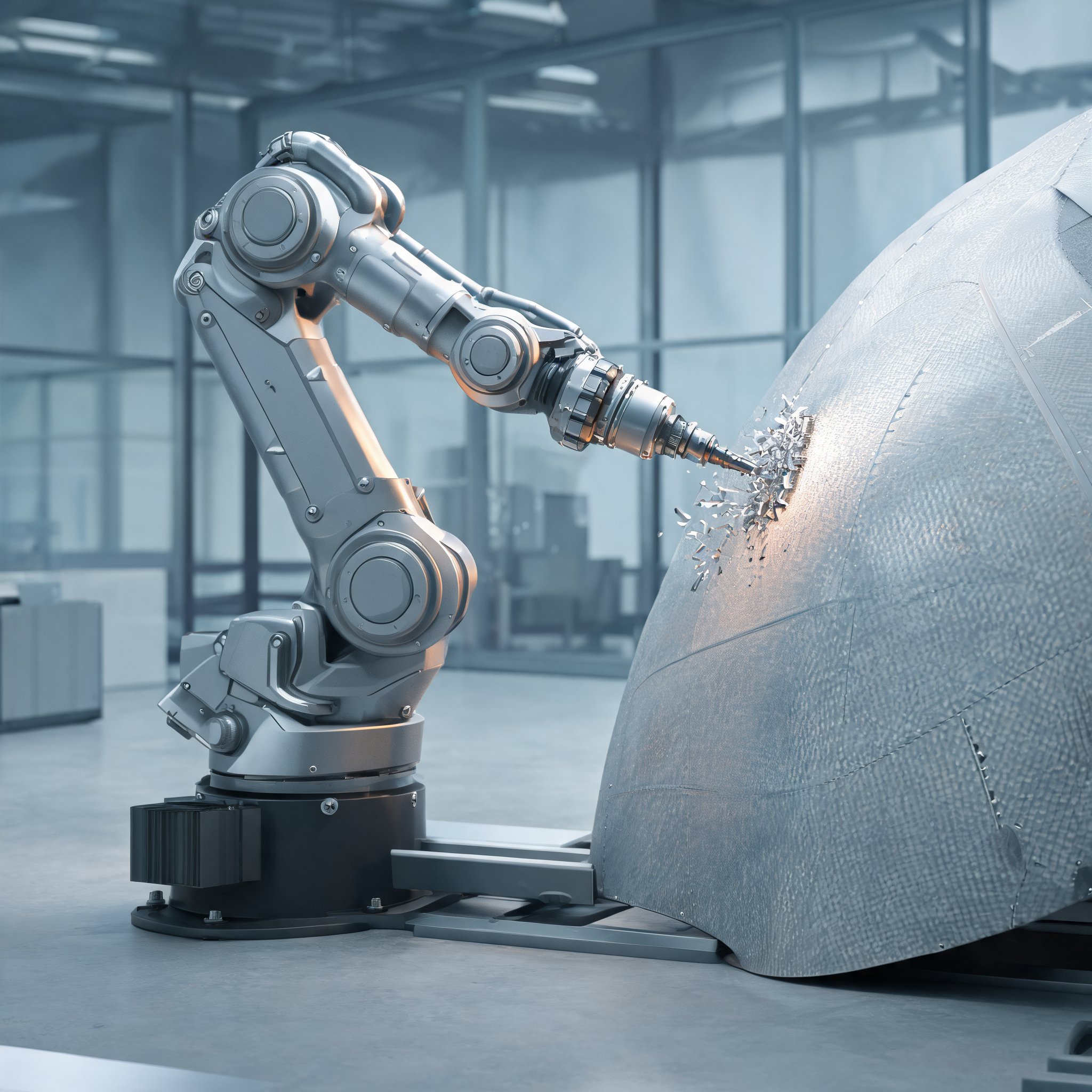
Fives High Precision Machines (Fives HPM) is promoting the Liné Machines RoboTDM as an alternative to moving very large components through a conventional CNC machine tool. The system mounts a spindle, toolholder and cutter on an industrial robot so that milling, trimming and drilling operations can be performed directly on the workpiece.
The approach is aimed at parts whose tolerances can be measured in tenths of a millimeter rather than hundredths. Fives says RoboTDM is suitable where tolerances down to approximately 0.1 mm are acceptable. In that range, the company argues, a large CNC machine may add cost and floor-space requirements that the application does not need.
Bringing the tool to the part
RoboTDM is part of Fives’ Material Removal business line. Instead of bringing a large component into a machine envelope, the robot carries the machining capability to the part. Fives says this can shorten setup, simplify programming and reduce equipment requirements for suitable work. The company lists face milling, deburring, weld-bead trimming, pilot-hole drilling, routing, edge contouring and pocketing among possible operations, including work on large aerospace panels, automotive body parts and composite or thermoplastic fabrications.
The concept depends on closing the accuracy gap that has limited industrial robots in machining. Fives says conventional robotic systems typically achieve tolerances around 0.3 mm, which is insufficient for many material-removal tasks. Its development work for RoboTDM therefore focused on high-precision robotic machining, combining robot calibration with look-ahead and motion-planning algorithms.
According to Fives, these algorithms allow programs containing more than one million points to be processed without latency that could otherwise compromise robot motion. The claimed result is smoother trajectory execution and support for multi-axis contouring and complex machining operations. Fives says RoboTDM can reduce machining deviation to as little as 100 μm, or 0.1 mm, a threefold improvement over conventional robotic accuracy.
Configurable machining package
The end effector can be configured with different spindle sizes, power ratings, torque and speed. Fives lists available spindle power up to 125 kW, torque up to 80 Nm and speeds reaching 30,000 rpm, with HSK A63, HSK F63 or HSK A100 taper toolholders. The system can also include automatic tool changing, tool measurement, tool-breakage detection and part probing, while a vision system can support drilling. Beyond machining, Fives says RoboTDM can be configured for waterjet cutting, laser profiling and ultrasonic cutting.
Fives reports that a multi-year research and development project and development trials demonstrated cycle-time reductions of up to 70% in trimming and milling, with some individual applications achieving greater savings. Those figures are company claims from development work rather than a general guarantee. The physical layout is also intended to help with components that are too large or awkward to move through a conventional machine tool. RoboTDM can be configured with multiple workstations and customized peripheral equipment, and Fives says its relatively modest foundation requirements simplify installation compared with a large CNC machine.
Where the system fits
Fives identifies aerospace, defense, maritime and energy as sectors where component dimensions can be substantial and production requirements vary. The company does not present RoboTDM as a universal answer. Where tolerances tighter than 0.1 mm are required, it says a high-precision CNC machine remains the appropriate choice, making the robotic system complementary to Liné Machines and the wider Fives HPM machine-tool portfolio.
The RoboTDM is produced at Fives Liné Machines Inc. in Granby, Quebec, Canada, a site with almost 50 years of presence in North America. The plant makes Liné CNC machine tools and robotic solutions, and the site also supports engineering, integration, automation, service and training. For Fives, the system represents a way to apply 'precision at scale' by matching the accuracy level to the application rather than defaulting to a large machine.