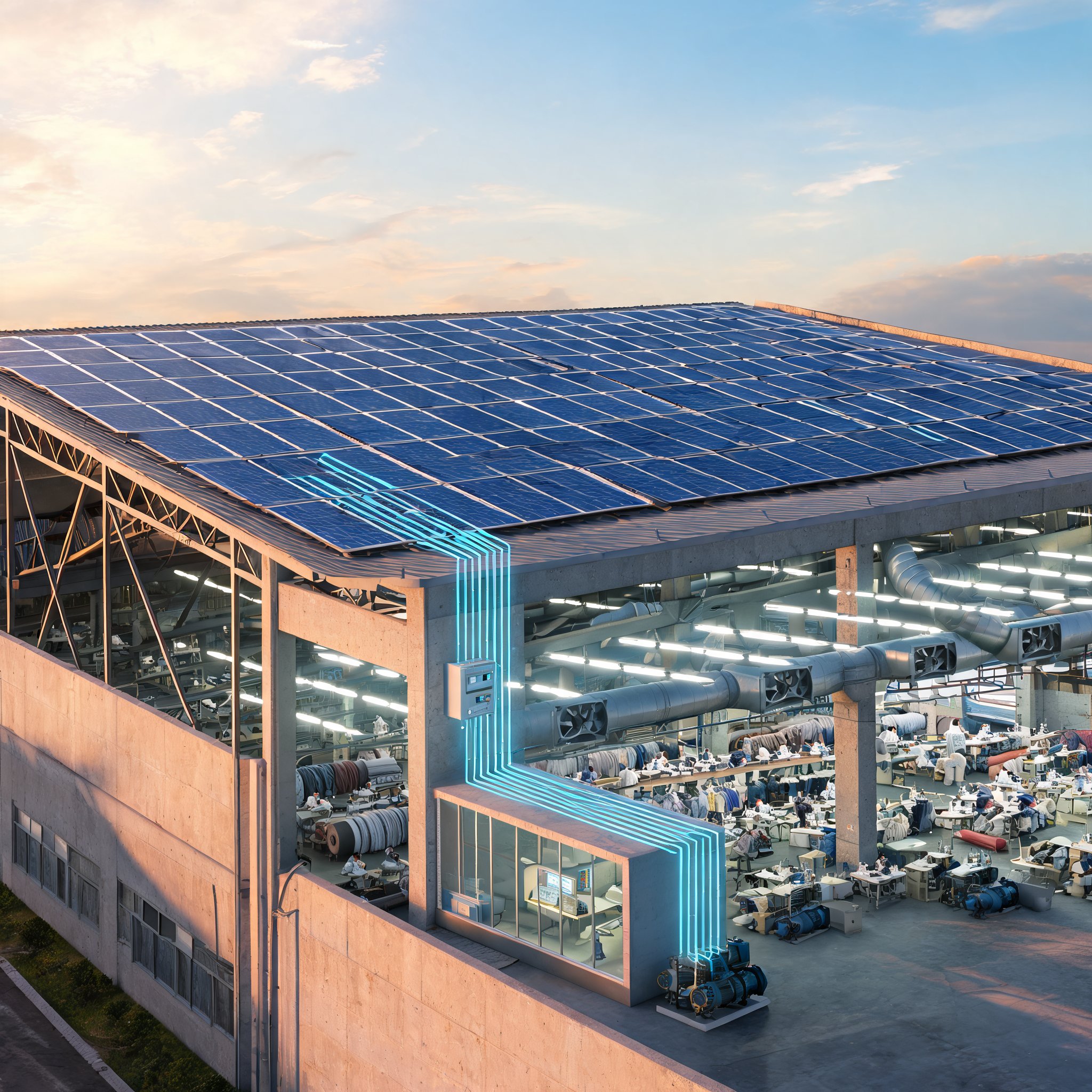
HAMS Garments Ltd. says it has achieved a 78.1% reduction in CO2 emissions and has received the World Championship for Energy Savings (WCES) Certificate. The recognition positions the Bangladesh apparel manufacturer as a contender for the 2026 WCES Award.
The project centered on an existing garment manufacturing facility with a gross floor area of 203,030 sq.ft. (18,861.95 m²) and approximately 3,216 regular occupants. Instead of replacing the building, HAMS pursued an operational transformation intended to cut energy use while maintaining production requirements and occupant conditions.
Efficiency and renewable energy measures
HAMS implemented a coordinated package of efficiency measures identified through ASHRAE Level 1 and Level 2 energy audits. The work included upgrading and optimizing energy-consuming equipment and systems, improving lighting efficiency, reducing unnecessary electrical loads, optimizing motors and pumps, and improving ventilation and cooling performance. Stronger energy metering and sub-metering were added to improve visibility of consumption and support corrective action.
A 550 kW on-site solar photovoltaic system was a major investment, reducing dependence on grid electricity and fossil-fuel-based energy. Renewable energy now represents approximately 47.36% of the project’s energy use. Together with the efficiency measures, these actions contributed to an overall 75.25% energy saving.
The facility’s LEED v4 Existing Buildings: Operations & Maintenance Platinum certification, with 108 out of 110 points, is cited as independent evidence of the approach’s effectiveness. The project is presented as demonstrating the decarbonization potential of an existing industrial building.
Operational control and demand response
HAMS complements capital investments with energy management and operational optimization. Energy performance is continuously monitored through metering, equipment trend reviews and building-management practices, allowing the facility team to identify abnormal consumption and operational inefficiencies. The project also introduced ongoing commissioning, preventive-maintenance planning, equipment performance monitoring and defined operational responsibilities.
Energy use is periodically reviewed against expected performance so that corrective actions can be taken rather than allowing inefficient operation to continue unnoticed. A demand-response program, including a 10% demand-reduction drill, demonstrates the facility’s ability to manage electrical demand during periods of grid stress. Operating schedules and equipment use are reviewed to minimize unnecessary loads while maintaining manufacturing requirements.
Staff engagement and everyday operation
HAMS recognises that technology alone cannot deliver lasting energy savings. Facility and maintenance personnel receive training on efficient operation, preventive maintenance, energy monitoring and corrective actions. Operational procedures encourage equipment to run only when required, unnecessary loads to be switched off, and energy-intensive activities to be managed without compromising production, safety or occupant comfort.
Employees are engaged in the broader sustainability program and encouraged to use energy and other resources responsibly. Structured action plans, assigned responsibilities and periodic performance reviews support accountability. This combination of technology, operational discipline and behavioral engagement has helped embed energy efficiency into daily factory management, according to the report.
The project offers a replicable example for the apparel sector: substantial energy savings can be achieved not only through capital investment but also through better operation, informed users and continuous performance management. The reported results cover an existing, operating garment factory rather than a new-build project.