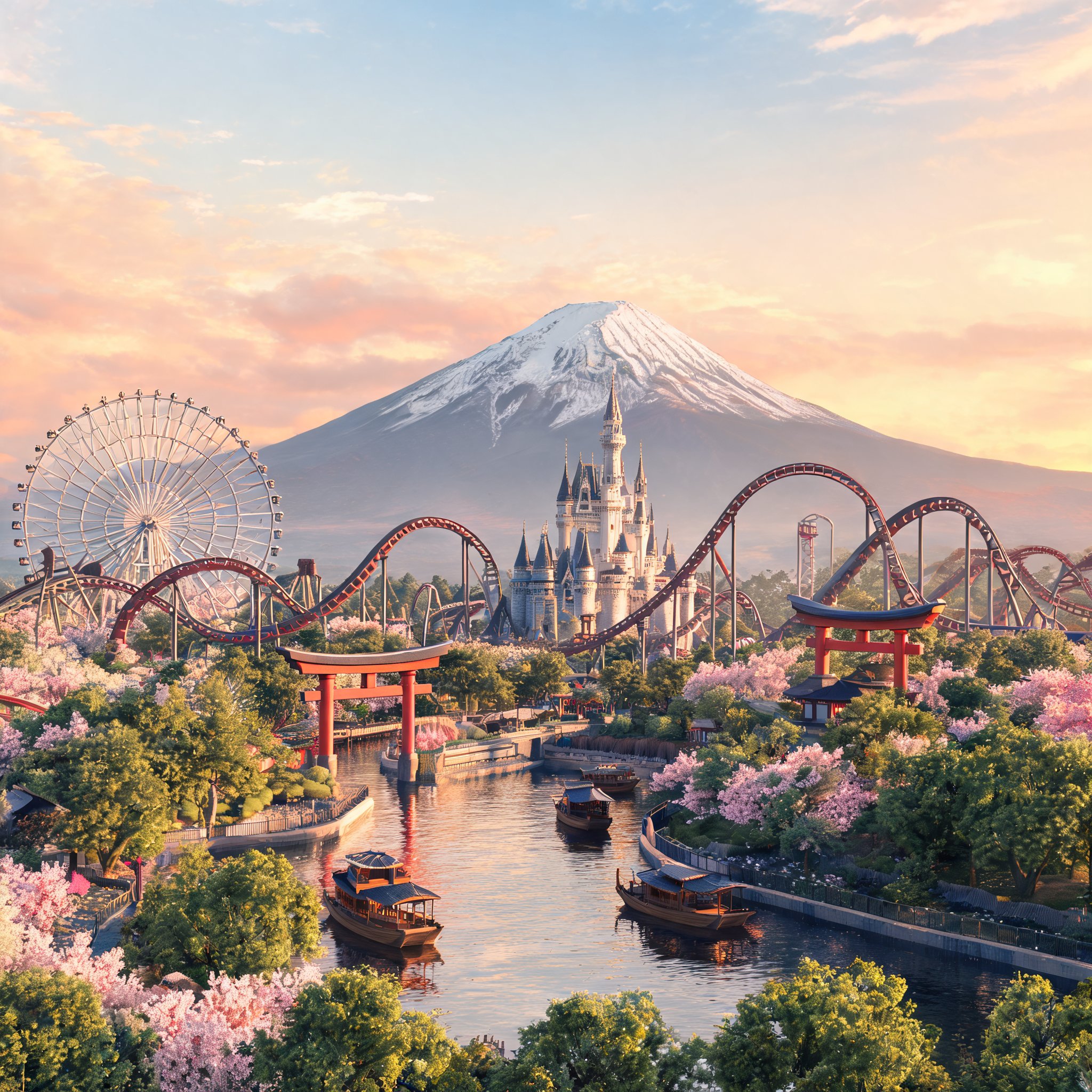
Japan's theme park landscape stretches from record-breaking roller coasters and immersive themed lands to character attractions based on films, games and television series, according to a Blooloop roundup of 18 parks nationwide. The feature notes that Japan welcomed a record 42.7 million international visitors in 2025, and that its theme parks have become a major draw alongside the country's culture, cuisine and scenery.
Disney and Universal
Tokyo Disneyland opened on 15 April 1983 as the first Disney theme park outside the United States. Based on the original Disneyland in California, it is divided into seven themed lands. Together with Tokyo DisneySea, it is owned and operated by the Oriental Land Company under licence from The Walt Disney Company, making them the only Disney parks in the world not owned by Disney. Tokyo DisneySea opened in September 2001 across 49 hectares and seven themed ports. In 2024 the resort opened Fantasy Springs, described as its largest expansion to date, a $2.2 billion project with worlds inspired by Frozen, Tangled and Peter Pan.
Universal Studios Japan opened in Osaka in 2001 and became the first Universal park to open Super Nintendo World in 2021, adding the world's first Donkey Kong Country area in 2024. It also hosts limited-time collaborations based on franchises including Demon Slayer, Jujutsu Kaisen, Pokémon, One Piece and Resident Evil. In 2026 the park announced its first expansion since 2001, with plans to invest up to 300 billion yen across 60,000 square metres of nearby land.
Studio Ghibli and Pokémon
Ghibli Park, inside the Expo 2005 Aichi Commemorative Park, opened in November 2022 with three of its five themed areas; Mononoke Village followed in November 2023 and Valley of Witches in March 2024. The park has no major thrill rides, focusing instead on recreations such as Howl's Moving Castle, a My Neighbour Totoro-themed playground and Catbus electric vehicles. In 2026 it announced plans for an indoor area inspired by the 1984 film Nausicaä of the Valley of the Wind.
PokéPark Kanto, described as the world's first permanent outdoor Pokémon attraction, opened in February 2026 at Yomiuriland in Tokyo. The 26,000-square-metre site features more than 600 Pokémon across Pokémon Forest and Sedge Town, plus two attractions, Pika Pika Paradise and Vee Vee Voyage. Tickets include admission to Yomiuriland, whose rides require separate tickets.
Thrill rides and regional parks
Fuji-Q Highland, which opened in 1968, is known for coasters including Fujiyama, Eejanaika and Takabisha and for views of Mount Fuji. Nagashima Spa Land, opened in 1966, has 13 operating coasters — more than any other Japanese amusement park — including Steel Dragon 2000.
- Huis Ten Bosch, opened in 1992 in Sasebo, Nagasaki, recreates a Dutch town and, at about 152 hectares, is Japan's largest theme park by area; in 2025 it opened what it describes as Japan's first premium flying theatre, with an 8K LED dome screen.
- Legoland Japan opened in Nagoya in April 2017 as Japan's first Legoland park and the second in Asia; its Miniland Japan uses more than 10 million Lego bricks.
- Moominvalley Park opened in March 2019 in Hanno, Saitama, as the second Moomin-themed park in the world and the first outside Finland.
- Edo Wonderland Nikko Edomura, a 49.5-hectare cultural park in Tochigi, recreates an Edo-period town with period costume and performances.
- Asakusa Hanayashiki, established in 1853, is considered Japan's oldest amusement park and has the country's oldest surviving roller coaster, built in 1953.
- Greenland in Arao City, Kumamoto, is among Kyushu's largest parks, with around 80 attractions and a 105m-high Ferris wheel.
- Sanrio Harmonyland in Hiji, Oita, opened the Nakayoku Lab area in 2026, including an immersive AR experience with Sanrio characters.
- Hirakata Park, Osaka's oldest amusement park, dates to 1910 and attracts around 1.3 million visitors a year.
- Sylvanian Park in Ibaraki is a Sylvanian Families-themed attraction within the larger Komorebi Mori no Ibaraido leisure park.