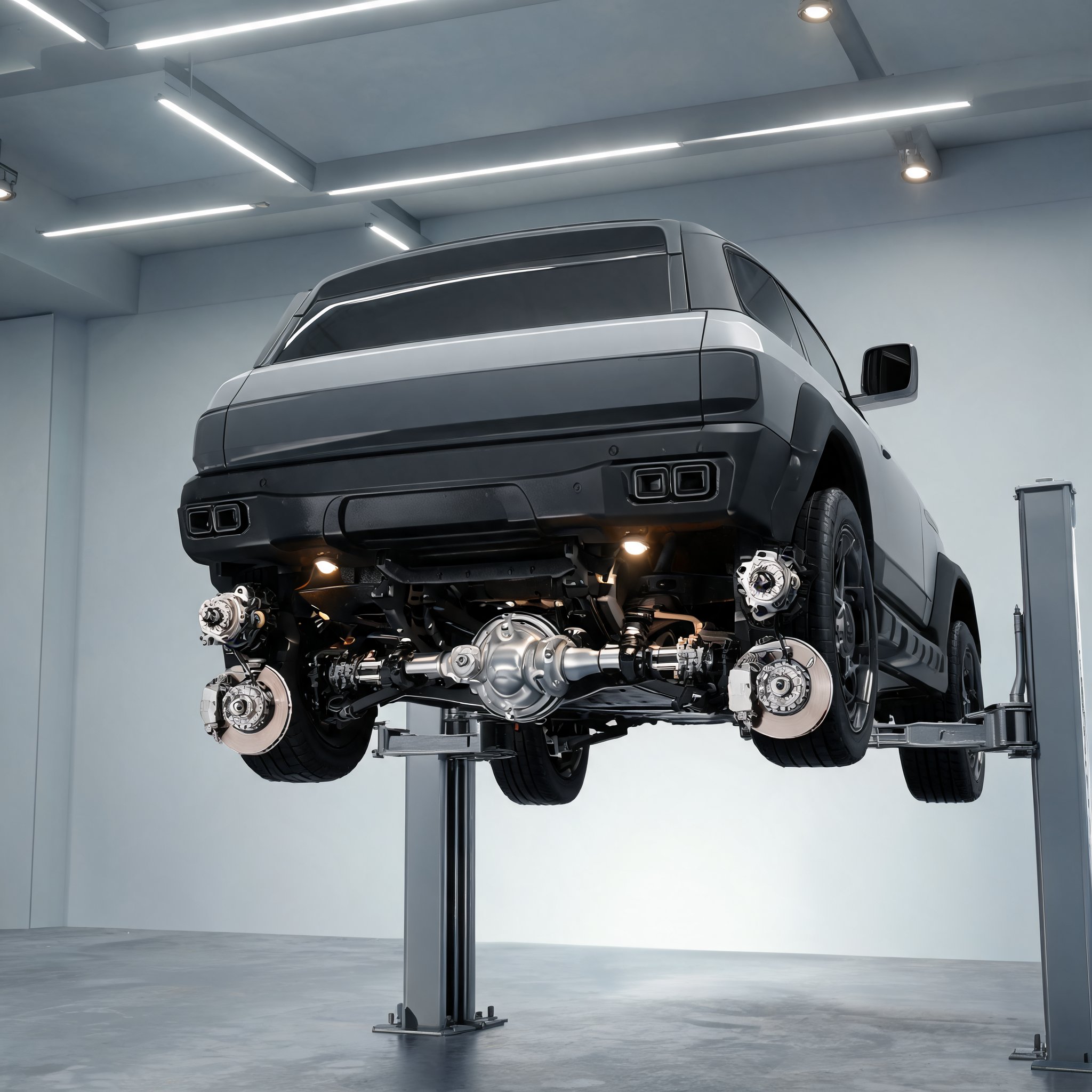
Portal axles are prized in hardcore off-roading because they lift a vehicle’s drivetrain without hanging lots of hardware below the frame. They are also expensive: a typical set from companies such as 74Weld costs about $20,000. Zeph Gage’s Jeep build takes a different route. He installed a portal axle only on the rear, using a flipped differential and a mix of production and adapted parts to deliver the clearance benefit at roughly one-fifth the cost.
How the budget portal axle works
Gage’s assembly starts with a Ford 9-inch axle housing, geared hubs from a Humvee and a set of Jesse Haines Fabrication HMMWV portal adapters. Two-gear portals like the Humvee’s reverse the rotation of the input shaft. To correct that reversal with the Ford 9-inch, Gage turned the differential upside down so the driveline would spin in the proper direction. A Yukon Gear and Axle third member is then bolted to the differential, turning low-pinion parts into an effective high-pinion arrangement.
The layout is more than a cost trick. It adds about six inches of clearance, retains full shock travel and reduces stress on the differential. Gage’s build is intended to be effectively bulletproof as a result. Retaining full shock travel is notable because portal-axle conversions can make that difficult.
Why the front axle stays conventional
Installing a portal only at the rear may look unusual, but it is a common approach in the remote-control rock-crawler scene. By keeping the front solid axle, Gage avoids the packaging constraints that can arise when adding portal axles to a vehicle that never had them from the factory. He also does not have to limit shock travel to solve those constraints, and the ride height does not rise to an extreme level. The result is presented as a best-of-both-worlds arrangement: extra clearance at the rear without a wholesale redesign at the front.
Custom fabrication, not an off-the-shelf kit
The conversion is not a bolt-on package. Gage carried out substantial custom fabrication, including homemade brackets, custom-tapped plates and a two-piece brake rotor paired with a Ford Fusion caliper. The Fusion hardware was chosen partly because it offers an integrated electric emergency-brake solenoid, as well as for clearance reasons.
In its current form, the XJ Jeep can drive over a five-gallon bucket and still retain several inches of spare clearance. That matters because the rear end will not get hung up on obstacles that the front end can simply steer around. The result is an ingenious piece of kit that required considerable thought to get right, and a video from Outdoor Auto covers further specifics such as how the gearing was matched front and rear.