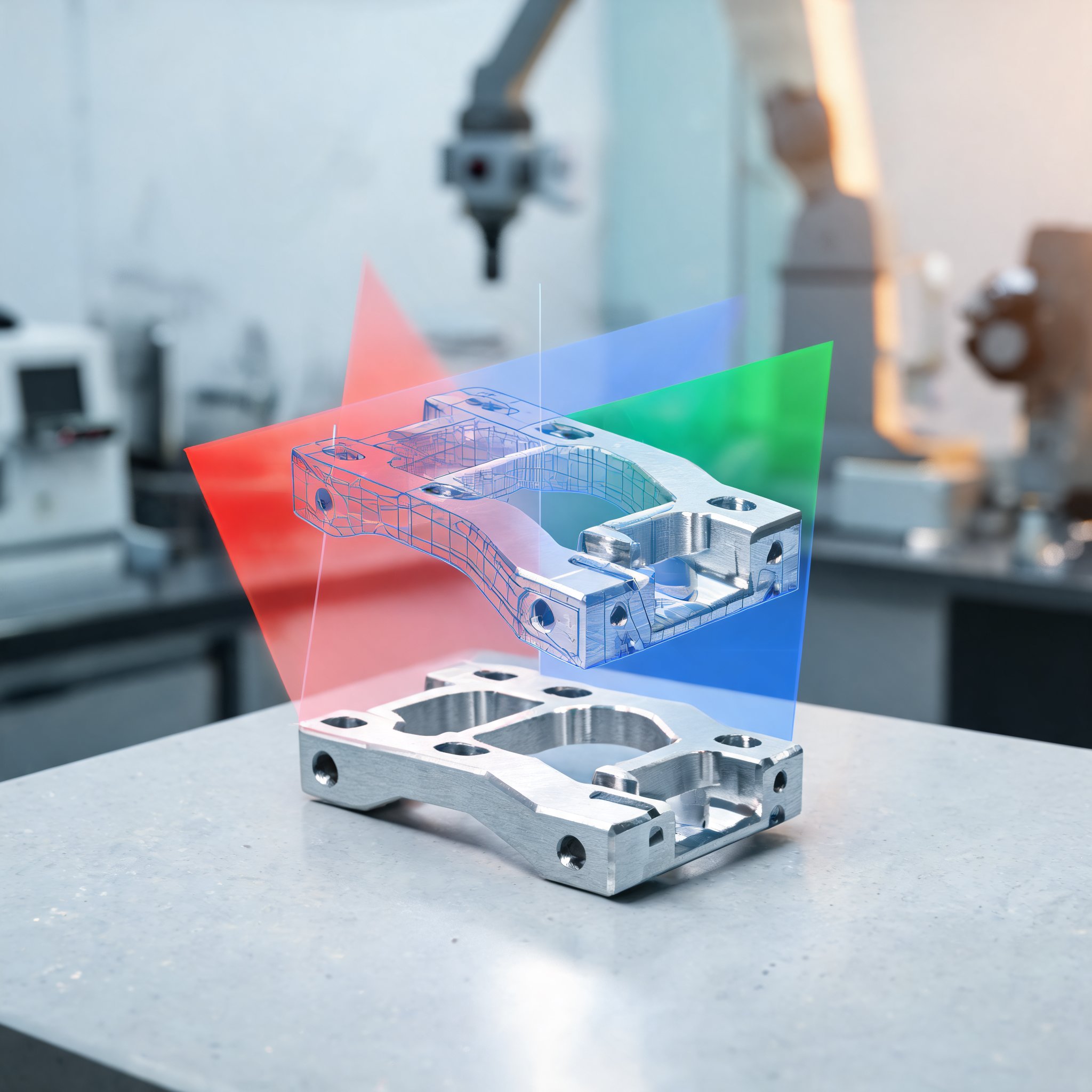
Geometric Dimensioning and Tolerancing (GD&T) is the language that connects design, production and metrology. When it is applied well, a part assembles and functions as intended; when it is misinterpreted, teams can end up with conflicting measurements, scrap and costly back-and-forth. Metrologic DCS has outlined four ways to reduce those gaps as Product Manufacturing Information (PMI) becomes more common in CAD files and standards continue to evolve.
Begin with PMI and preserve design intent
The first step is to decode the design intent carried by PMI: which feature is targeted, which references apply and which tolerance is specified. According to Metrologic DCS, doing this manually is error-prone. A value copied incorrectly or a reference misunderstood can lead to a part being inspected against a requirement that was not the one specified. The company recommends software that takes PMI as its starting point instead of asking users to re-enter tolerances. Features and their evaluations can then be created from the part’s digital definition. Metrologic DCS says this avoids re-keying, reduces interpretation gaps and saves time from the first stage of program preparation.
Automate datum reference frames
The Datum Reference Frame (DRF) defines where measurement begins. It is made up of reference features, commonly A, B and C, and determines which degrees of freedom are constrained for an evaluation. The company states that if the DRF is built in the wrong order, or if degrees of freedom are poorly selected, the same part can be declared conforming or non-conforming depending on the operator. Metrologic DCS describes this as a major source of GD&T misinterpretation. Its recommendation is to automate the step so that the DRF and degrees of freedom follow the drawing definition rather than an operator’s choice. That approach, it says, makes results repeatable from one operator, machine and site to the next. In Metrolog, the company’s software, the DRF is created automatically when a GD&T is evaluated, with degrees of freedom selected accordingly.
Reuse imported DRFs and track progress
Reference features are already defined in the CAD model, where references A, B and C carry labels placed by the design office. Recreating them during program preparation wastes time, can introduce discrepancies and forces rework whenever the definition changes, according to Metrologic DCS. On a part with many annotations, it can also be difficult to tell which annotations have been handled and which still need measurement. The company advises starting from DRFs that come from PMI and predefining GD&T from them. It also recommends keeping a clear view of progress, including where each annotation sits on the part and where its measurement stands. In Metrolog, Scan GDT reads decoded PMI and assigns a status so users can validate both decoding and measurement.
Make reports useful to the shop floor
A report limited to pass or fail does not tell the shop floor what to do. If a machine operator does not know what kind of defect is present, adjustments can become trial and error, producing scrap and correction loops. Metrologic DCS recommends tailoring the report to its reader: a table of numerical values for quality control, a Go/No-Go report for a quick decision and a decomposition analysis for the operator. In Metrolog, the defect of an evaluated feature is split into four independent types — form, size, position and orientation — alongside the global defect. According to the company, this makes it possible to see which type dominates and what to correct first. Metrologic DCS says a good report reduces scrap and speeds corrective action.