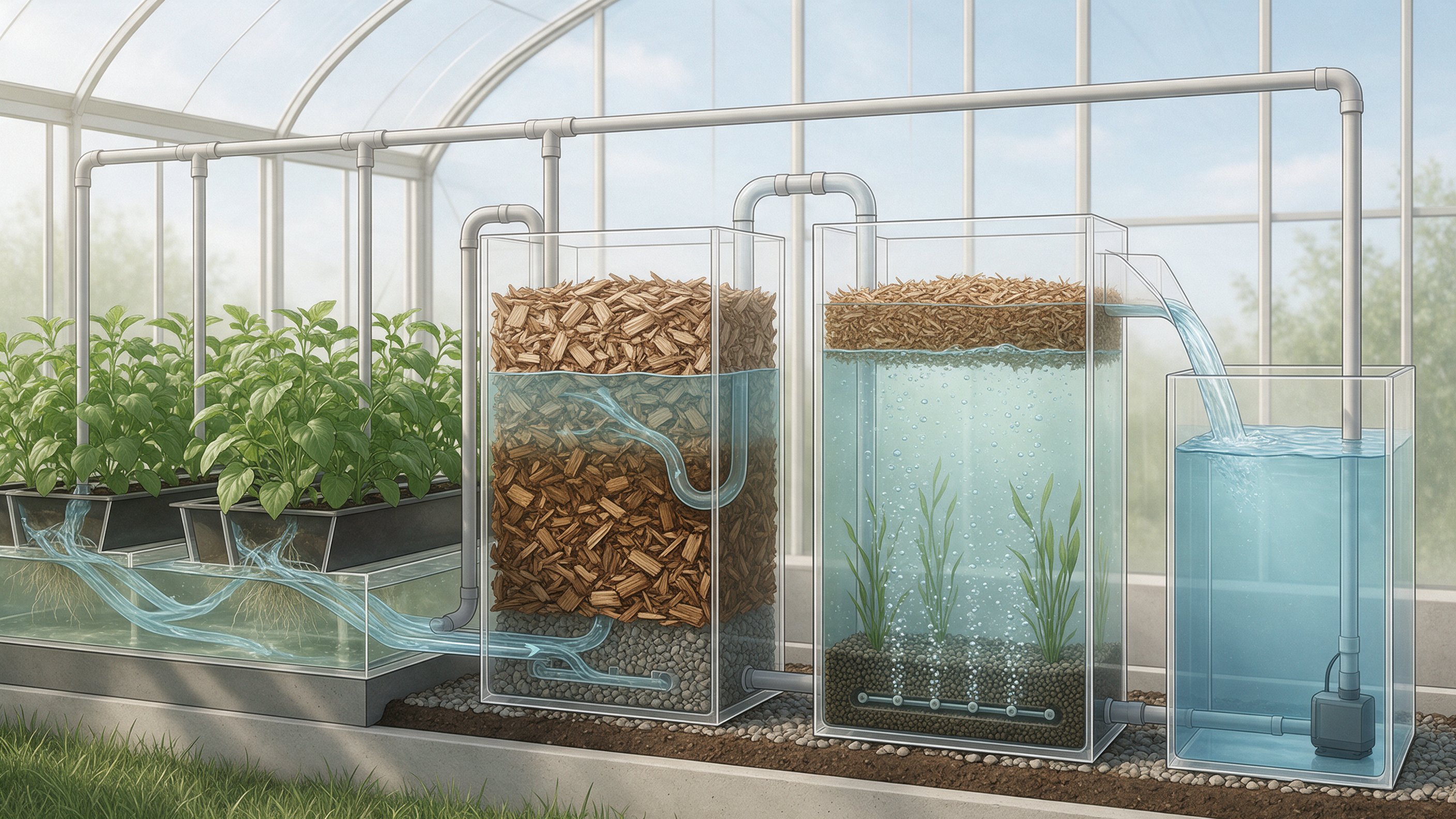
Michigan State University researchers are testing a two-stage woodchip bioreactor system designed to clean recycled greenhouse irrigation water, aiming to remove pesticides while keeping valuable nutrients in the water. The work, led by Dr. Tom Fernandez and supported by the American Floral Endowment, is focused on a treatment approach that could be practical, scalable and affordable for commercial greenhouses and nurseries.
Water recycling helps growers conserve water and reduce nutrient and pesticide losses, but runoff can carry fertilizers and crop protection products back into storage tanks, where they may accumulate. The research team is examining whether woodchips can address that challenge. A woodchip bioreactor is a tank or treatment area filled with woodchips through which water passes. The wood provides surface area for beneficial microorganisms and a carbon source that supports microbial activity, and it can also physically bind, or adsorb, some contaminants.
Why two stages
The project builds on agricultural use of woodchip systems to remove nitrate from drainage water. Fernandez’s research has also shown that woodchip systems can remove phosphorus and pesticides when water remains in the bioreactor for longer. For this project, the team created a two-stage system: water first passes through a non-aerated woodchip bioreactor with relatively low oxygen levels, then moves into a second bioreactor that is continuously aerated. The design is intended to support different microbial communities, because some pesticides may break down more effectively under aerobic conditions while others respond better to low-oxygen environments.
Field testing at a wholesale greenhouse
The researchers installed bioreactors at a wholesale greenhouse in Michigan. The system treated return water from approximately 11,500 square meters of greenhouse production. Two different-sized systems were tested. In one, water remained in each treatment stage for about 30 minutes; in the larger system, it remained for about 60 minutes. Researchers collected water throughout the production season and analyzed it for nutrients, water-quality characteristics and hundreds of pesticides.
Early results show that the two-stage systems successfully created the different oxygen conditions the researchers were seeking, allowing them to study how those environments affected nutrient recycling and pesticide treatment. The systems generally retained a high percentage of the nitrogen and phosphorus already present in the irrigation water. Nitrogen recycling often exceeded 80% and, under some conditions, averaged about 91%. Phosphorus recycling was also high in the initial non-aerated treatment stage.
The systems needed an initial acclimation period, but their performance became more stable as the season progressed. The early results reported here focus on the system’s oxygen conditions and nutrient retention; pesticide removal is also part of the research. The American Floral Endowment, an independent nonprofit that funds floriculture and environmental horticulture research and scholarships, supported the work.